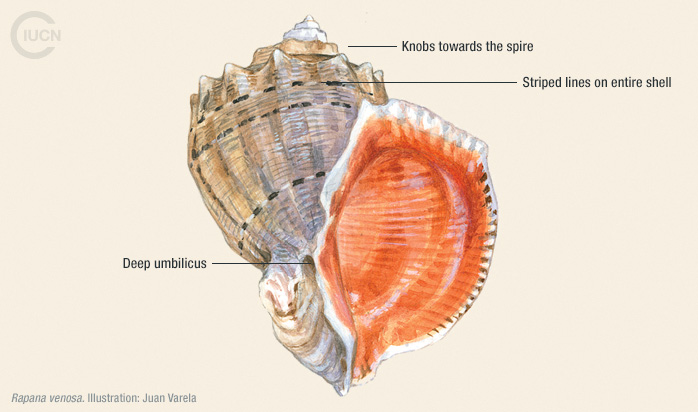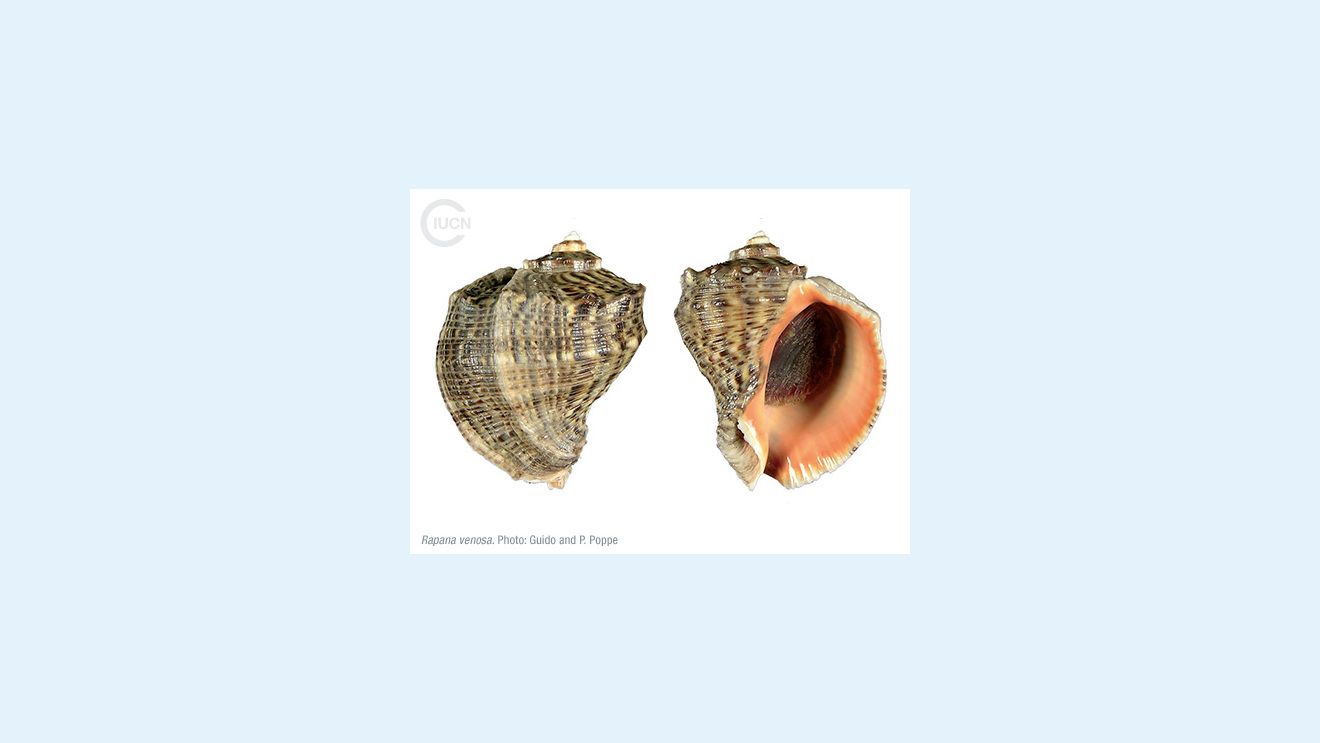
Rapana venosa
Information
The rapa whelk lives at depths of 2–40 m on sandy and rocky mixed bottoms in marine and brackish estuarine and, less frequently, inner lagoon waters. It often lies buried in the sand to avoid predators and preys on other mollusc species, such as oysters and clams. It tolerates low salinities, polluted waters and oxygen-deficient waters.
Artificial breakwaters, jetties and other man-made marine structures are optimal sites for its reproduction. At such sites rapa whelks congregate to mate and lay their eggs. They reproduce continuously from April to September at temperatures of 12–28 °C. Eggs are deposited in elongated (up to 2 cm) egg capsules that change colour from pale yellow to almost black as the embryos develop. After two weeks free swimming larvae are released into the water column; they later metamorphose into juvenile whelks and migrate to the sea bottom.
This whelk resembles the native whelk Stramonita haemastoma, but the smaller overall size (up to 7 cm), narrower aperture, lack of umbilicus and more tapered shape of the latter distinguish it from the non-native species.
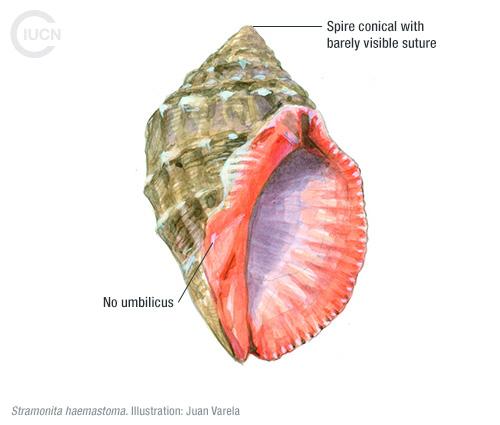
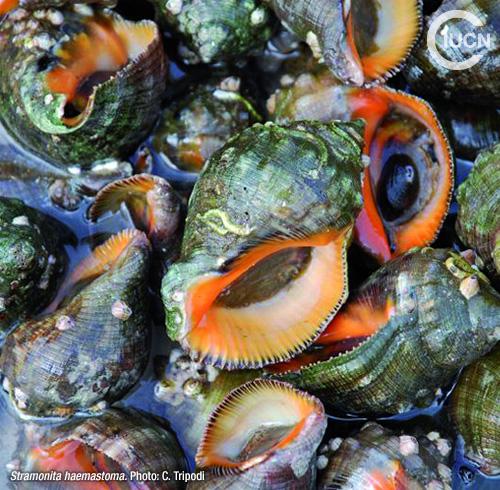
Originally from Sea of Japan, Yellow Sea and East China Sea, the rapa whelk was first introduced into the Black Sea and reported for the first time in the Mediterranean in Italy (Ravenna) in 1973. Thereafter, it spread all along the northern Adriatic coasts from the Marano lagoon to Ancona. There are also sporadic records of the rapa whelk in the Tyrrhenian Sea (from Livorno, Elba Island, Sabaudia, Messina and Cagliari). The species was also recorded from Greece (northern Aegean Sea) and Slovenia in the 1990s.
Larvae are likely to have arrived in ships’ ballast water, while young whelks could also have been hidden amongst commercial bivalve seeds and been transferred to new farm seedling areas.
The rapa whelk is a voracious predator of bivalve molluscs and may also compete with native species for space; it causes a major decline in local bivalve populations. In other invasive environments, young rapa whelks are generalist predators and consume large numbers of barnacles, mussels, oyster spat, and small oysters, as well as other whelks.
These whelks can decimate local shellfish populations and damage the industry that they support. They also use fishing nets for attaching their spawn, adding a lot of weight to the nets. Empty shells may be marketed as tourist souvenirs and the meat of this species is consumed along the Romanian Black Sea coast and in Turkey.
http://www.ciesm.org/atlas/Rapanavenosa.html
http://www.nobanis.org/MarineIdkey/Gastropods/RapanaVenosa.htm
http://www.europe-aliens.org/pdf/Rapana_venosa.pdf
ICES. 2004. Alien Species Alert: Rapana venosa (veined whelk). Edited by Roger Mann, Anna Occhipinti, and Juliana M. Harding. ICES Cooperative Research Report No. 264. 14 pp.