Arcuatula (Musculista) senhousia
Information
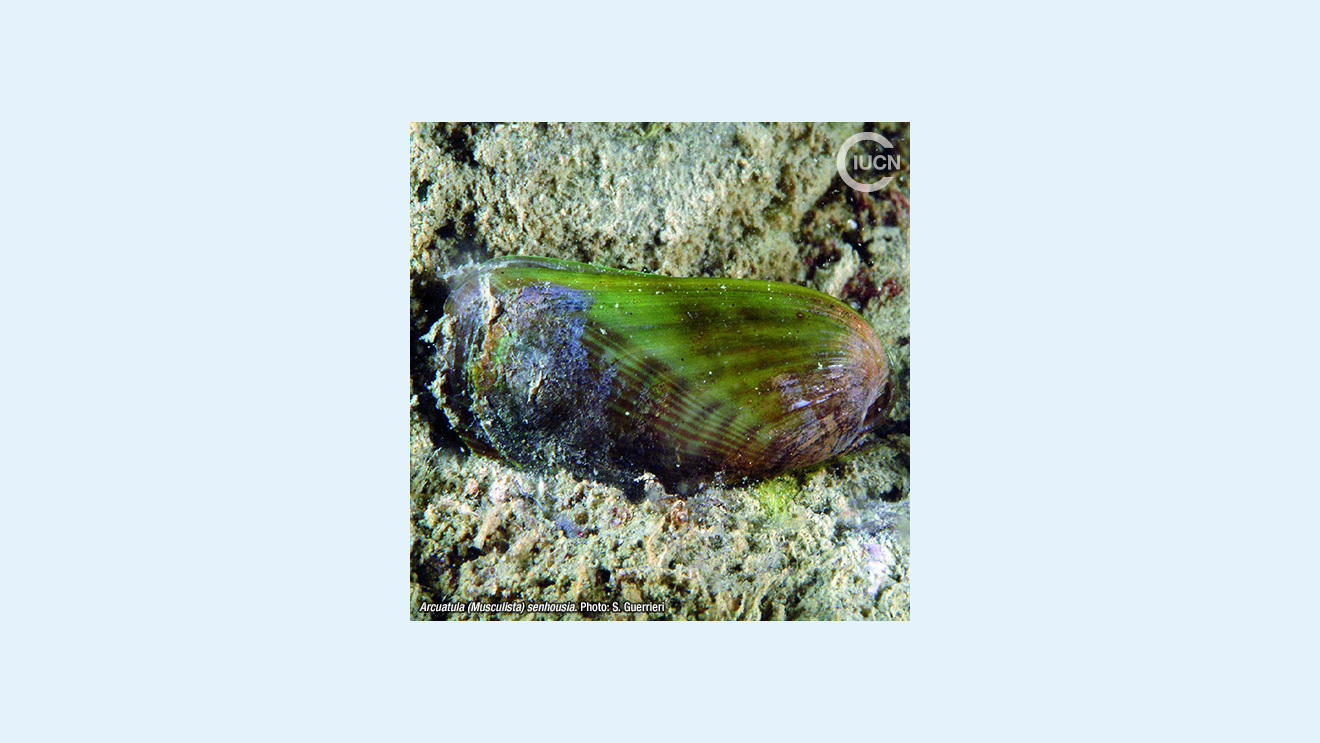
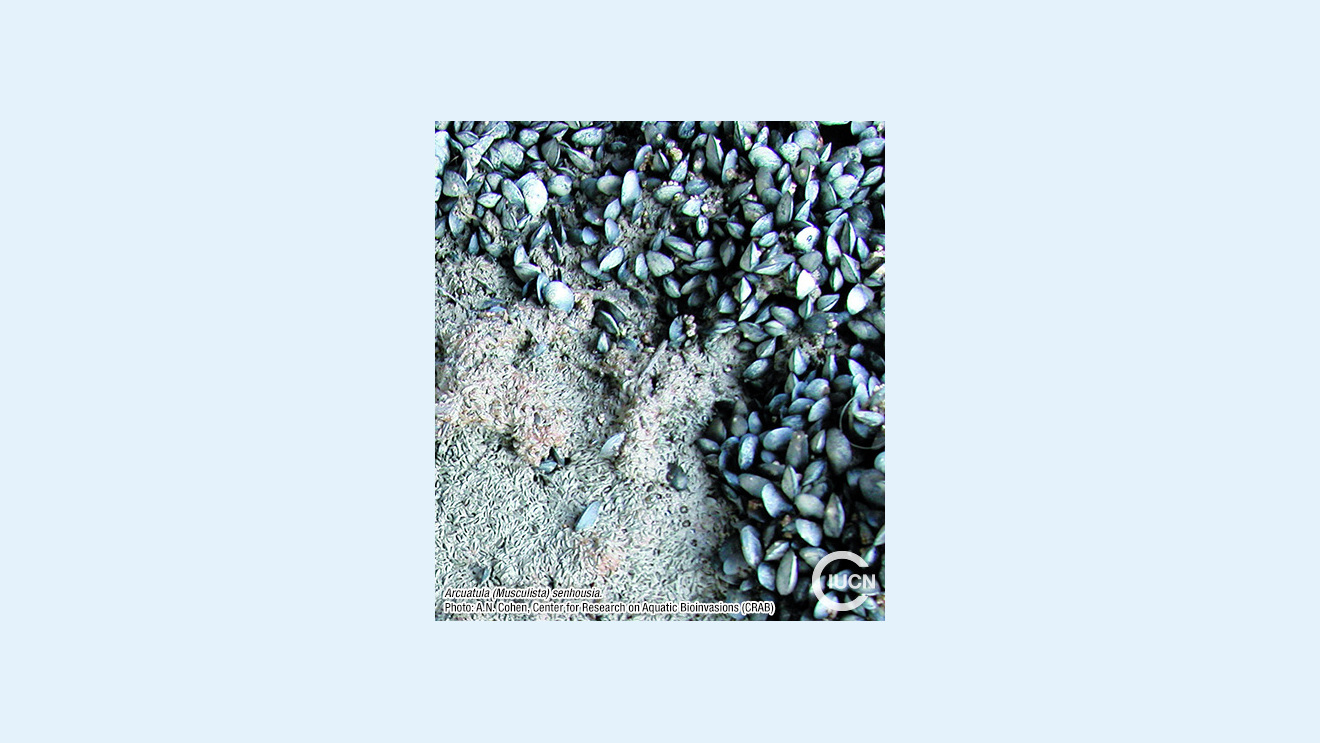
Arcuatula senhousia occurs on soft, muddy bottoms of bays and estuaries, preferably in sheltered areas from the intertidal zone down to a depth of 20 m. The mussels construct a nest of trapped sediment where many individuals live together. A. senhousia forms dense mats of individuals on the bottom (up to 8,000 individuals per square metre). Males and females are not different to the naked eye.
In the Mediterranean Sea, sperm and eggs are released in the water from September to November. It is a species with high fecundity, rapid growth and good dispersal ability, making it a successful invader. Larvae live in the plankton for up to 55 days until they settle on the bottom. The Asian date mussel can reach adult size in only nine months and live for a maximum of two years. Adults can live for several days out of the water; they are tolerant of low salinities, oxygen concentrations and temperatures.
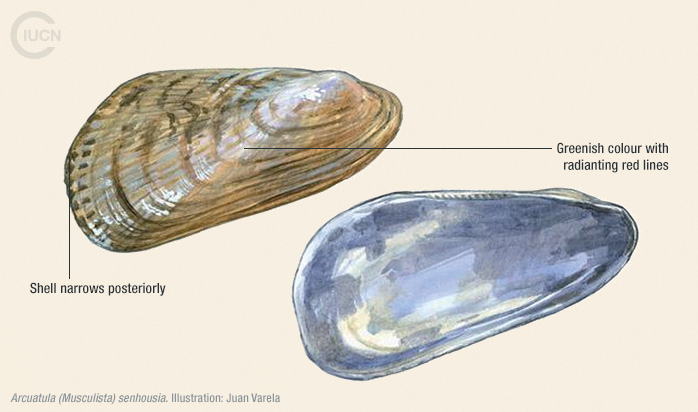
Mytilus galloprovincialis (young individuals). Arcuatula senhousia often lives in M. galloprovincialis beds, therefore young Mediterranean mussels can be confused with the alien species. Major differences are that in M. galloprovincialis: 1) the colour of the shell is shiny blue-violet or black; 2) the interior of the shell is mother-of-pearl; 3) it lacks red lines on the outer surface of the shell.


Originally from the south-western Pacific, it was first recorded in the Mediterranean at Tel Aviv (Israel) in 1960. Thereafter, it has been reported in Egypt (1969), France (1984), the Adriatic Sea (1992), Slovenia (1997), Italy (Gulf of Taranto) (2001), Italy (Leghorn) (2001), Sardinia (Gulf of Olbia) (2002), and Sicily (Siracusa) (2006). The main pathway of introduction is through transfer with bivalve seed stock for aquaculture purposes; this species can also be spread by ship’s ballast waters (water pumped into and out of ships as ballast to maintain the correct buoyancy) or fouling (the communities encrusting a ship’s hull).
Arcuatula senhousia forms dense aggregations that can change the physical structure of the bottom, dominating benthic communities and outcompeting other filter-feeding bivalves for food. It also develops on the roots of sea grasses slowing down their growth.
The species’ economic impact has not been quantified yet; however, it is highly possible that bivalve culture and harvesting might suffer due to strong competition. The Asian date mussel can damage marine engines by clogging cooling water intakes or industrial water intake pipes.