Crepidula fornicata
Information
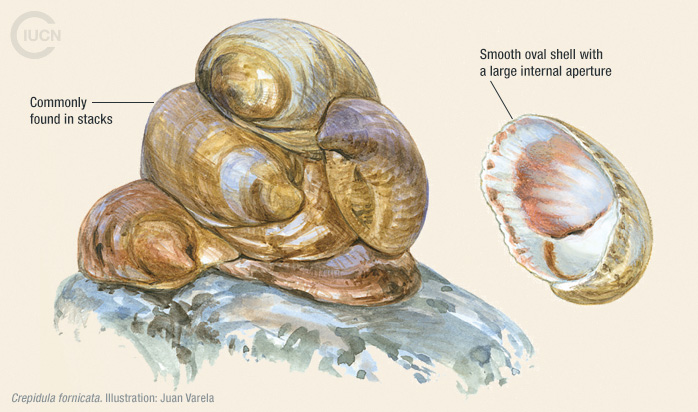
This species is a filter-feeder occurring within sheltered coastal bays and estuaries, sometimes in low-salinity environments. It settles on other shells or hard substrates on mud and sand-gravel bottoms from lowest water down to depths of about 30 m. It can also survive prolonged periods out of the water, especially if exposed to freezing temperatures, and polluted waters where turbidity is particularly high.
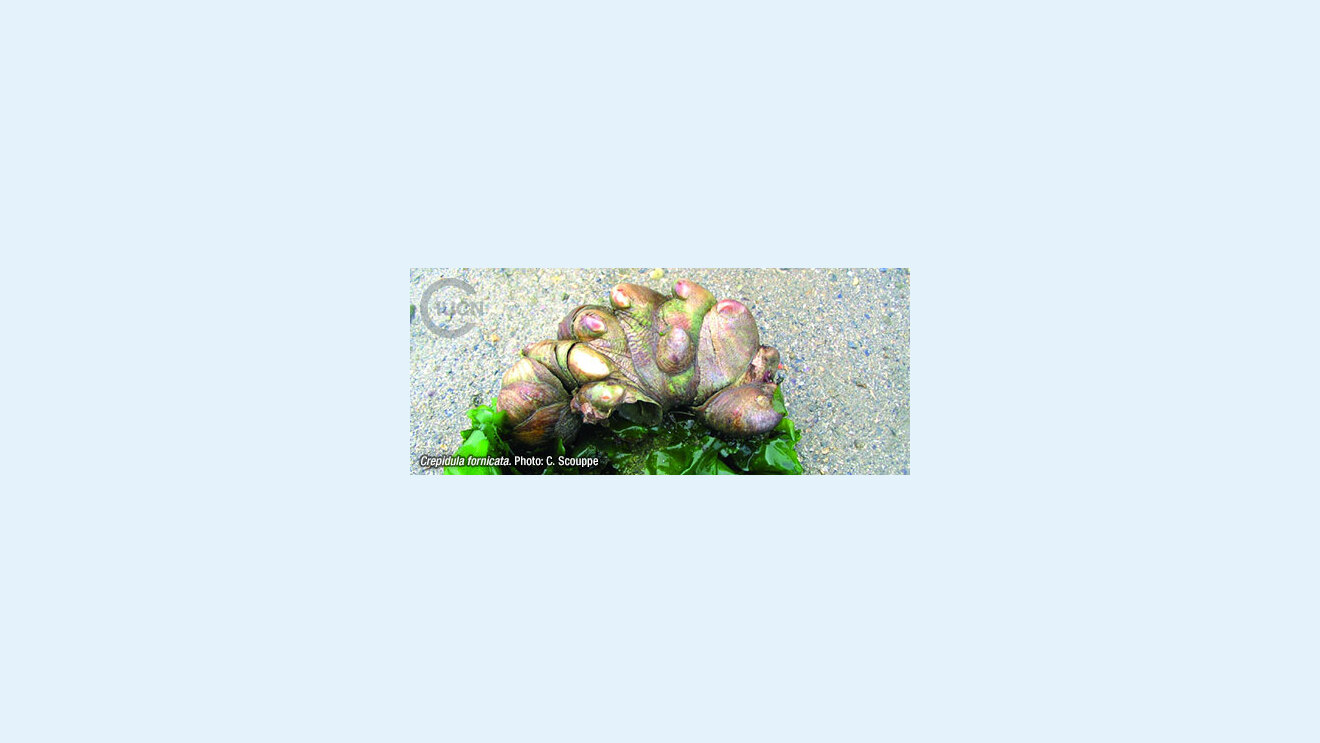
Crepidula fornicata is a hermaphrodite, changing sex during its life. Females brood eggs that are internally fertilized by males that stack on top of them. Usually a few large females are on the bottom and several smaller males stack on top. Eggs contained in capsules hatch into planktonic larvae which, after a short larval period, settle on hard substrates in response to a water-soluble chemical secreted by adults. They attach to a stack and reach maturity as young males in about two months, subsequently undergoing a sex change to become females. Occasionally solitary (not stackforming) individuals occur, in which case they selffertilize.
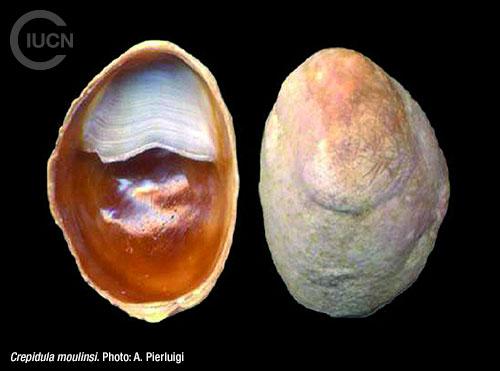
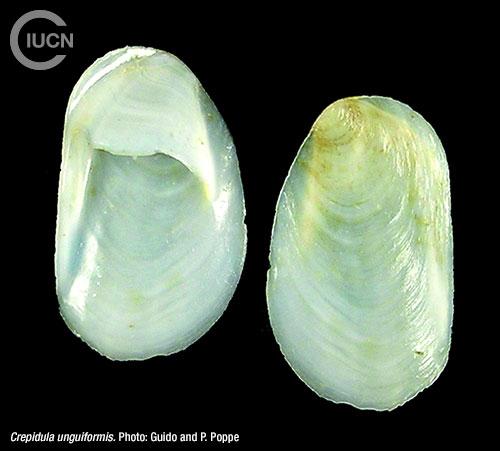
The native species Crepidula moulinsii and Crepidula unguiformis could be confused with C. fornicata. C. moulinsii has a more rounded and convex shell shape that shows a wrinkled surface and light brown stripes whereas C. unguiformis has a white shell of elongated shape and flatter surface.
Originally from the western Atlantic, from the St Lawrence estuary to northern Mexico, the species was first observed in Europe on the west coast of Britain in 1872, probably introduced in association with culture oyster spat, and it then spread along other European coasts. The slipper limpet may also potentially spread via boat fouling (in the communities encrusting a ship’s hull) or attached to floating objects and marine litter. In the Mediterranean it was first reported in southern France (Thau Lagoon) in 1982. Since then it has followed the same path as the Pacific oyster (Crassostrea gigas), having been reported also in Malta, Italy and Greece.
Its high-density colonies (up to several thousand individuals per square metre) have major effects on the macro-benthic fauna and flora, as they compete for food with other filter-feeding invertebrates and increase carbon release. Moreover, the production of large amounts of faeces and pseudo-faeces, increasing the deposition of mud, can have a considerable impact on sediment composition and the associated biota (such as free-living coralline algae).
An unexpected positive impact is that its feeding activities may prevent blooms of harmful algae.
The slipper limpet can become a pest on commercial oyster and mussel farms, reducing the productivity of aquaculture and natural harvesting grounds. Additional costs are associated with sorting and cleaning shells fouled by C. fornicata before marketing. It is also known to foul manmade structures and equipment.