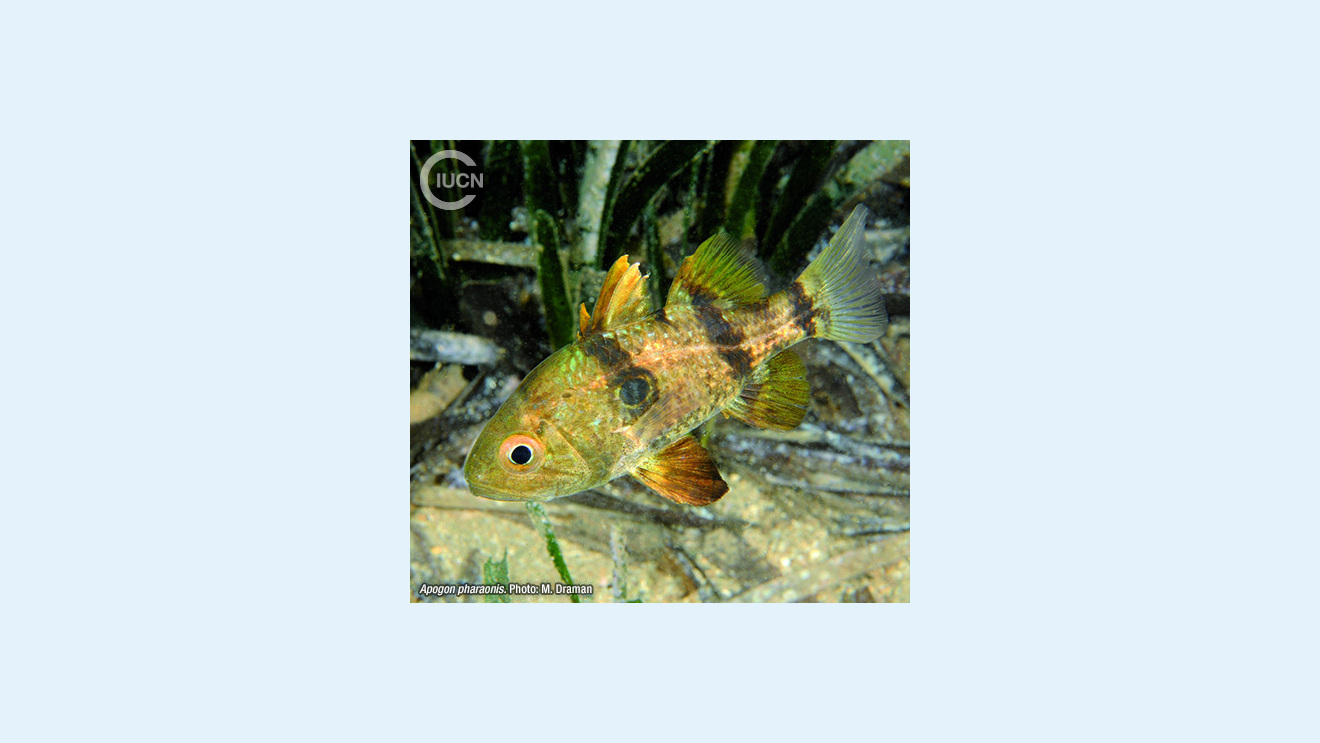
Apogonichthyoides pharaonis
Πληροφορίες
According to Gon and Randall (2003), the species formerly known in the Mediterranean as Apogon nigripinnis should be referred to as Apogonichthyoides pharaonis (common synonym Apogon pharaonis); Apogonichthyoides nigripinnis is restricted to the eastern Indian and western Pacific Oceans. According to FishBase only A. nigripinnis migrated to the Mediterranean through the Suez Canal, and A. pharaonis is not regarded as a migrant through the Suez Canal. However, we follow Zenetos et al. (2010) in considering only A. pharaonis to be a non-indigenous species in the Mediterranean.
The systematics of the Apogonidae is rather complex and accurate identification of the different species has to be done by a specialist in this group. These difficulties have resulted in several misidentifications in the literature. Consequently, all field observations of Apogonidae individuals must be checked by a specialist in this group to identify the species.
The adults occur inshore and on deep offshore reefs. It is a nocturnal species, like Apogon imberbis. During the day it is found among seagrasses or close to or inside small caves.
The males brood the eggs in their mouths until the young are free-swimming.
There are now several Apogonidae species in the Mediterranean, four of them non-indigenous.
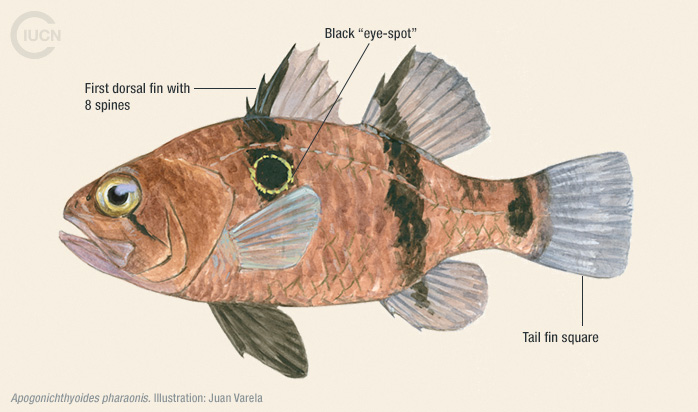
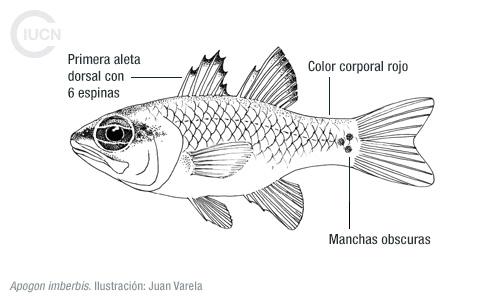
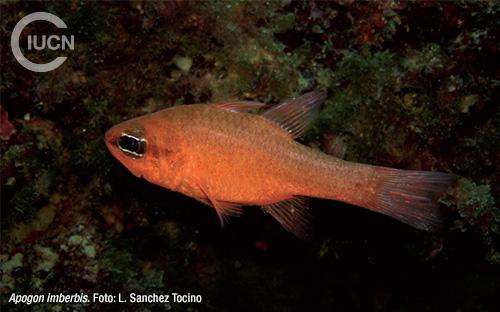
Apogon imberbis, the cardinal fish, is the only native species. It is easy to identify by its red colour and its 6 spines in the first dorsal fin.
The other cardinal species that have entered from the Red Sea are Apogon queketti, the spotfin cardinal, recorded off Turkey in the Levantine basin; Apogon smithi, Smith's cardinalfish, recorded off Israel; Ostorhinchus fasciatus, the broadbanded cardinalfish (reported as Apogon fasciatus) off Israel and Turkey and Cheilodipterus novemstriatus, the twospot cardinalfish recorded off Israel and Lebanon.
These Apogonidae species do not have the characteristic black ‘eye-spot’ on the body, and the body colour is tan to brown, with a pinkish tinge. O. fasciatus is clearly distinguished from the other Apogon species by a blackish mid-lateral stripe which extends to the end of the tail fin.
Due to taxonomic confusion and misidentification, the history of this cardinalfish’s introduction and its pathways are unclear. It is native from the Suez region of the Red Sea to South Africa. In the Mediterranean the Pharaoh cardinalfish was first recorded in Palestine in 1947, misidentified as Apogon taeniatus; it has subsequently been recorded in Cyprus and Turkey. The species is now common from the southern coast of Israel to the Levantine Sea.
The lack of nocturnal competitors might facilitate the population growth and spread of the non-indigenous species of Apogonidae, such as the bullseye, in the Mediterranean. The Apogonidae family constitutes the second largest species group by numbers in the sea around Turkey.
Other Pempheridae species such as Pempheris vanicolensis inhabit caves during the day. There is no documented evidence of competition between the Pharaoh cardinalfish A. pharaonis and P. vanicolensis or with the native species Apogon imberbis. However, daily migration movements of the Pharaoh cardinalfish out of the cave to forage at night and back in the morning may increase the transfer of organic matter into the cave and thereby have an impact on the caveassociated invertebrate fauna.
This species has been reared in captivity but is of low commercial value, except as ornamental fish species. The economic impact of its invasion is unknown.
Zenetos A. et al. 2010. Alien species in the Mediterranean Sea by 2010. A contribution to the application of European Union’s Marine Strategy Framework Directive (MSFD). Part I. Spatial distribution. Mediterranean Marine Science 11 (2): 381–493.
Gon O. and Randall J.E., 2003. A review of the cardinalfishes (Perciformes: Apogonidae) of the Red Sea, Smithiana Bulletin, Vol. 1-48 pp.