Plotosus lineatus
Πληροφορίες
This is the only catfish found in estuaries, lagoons and open coasts of of sandy and muddy habitats.
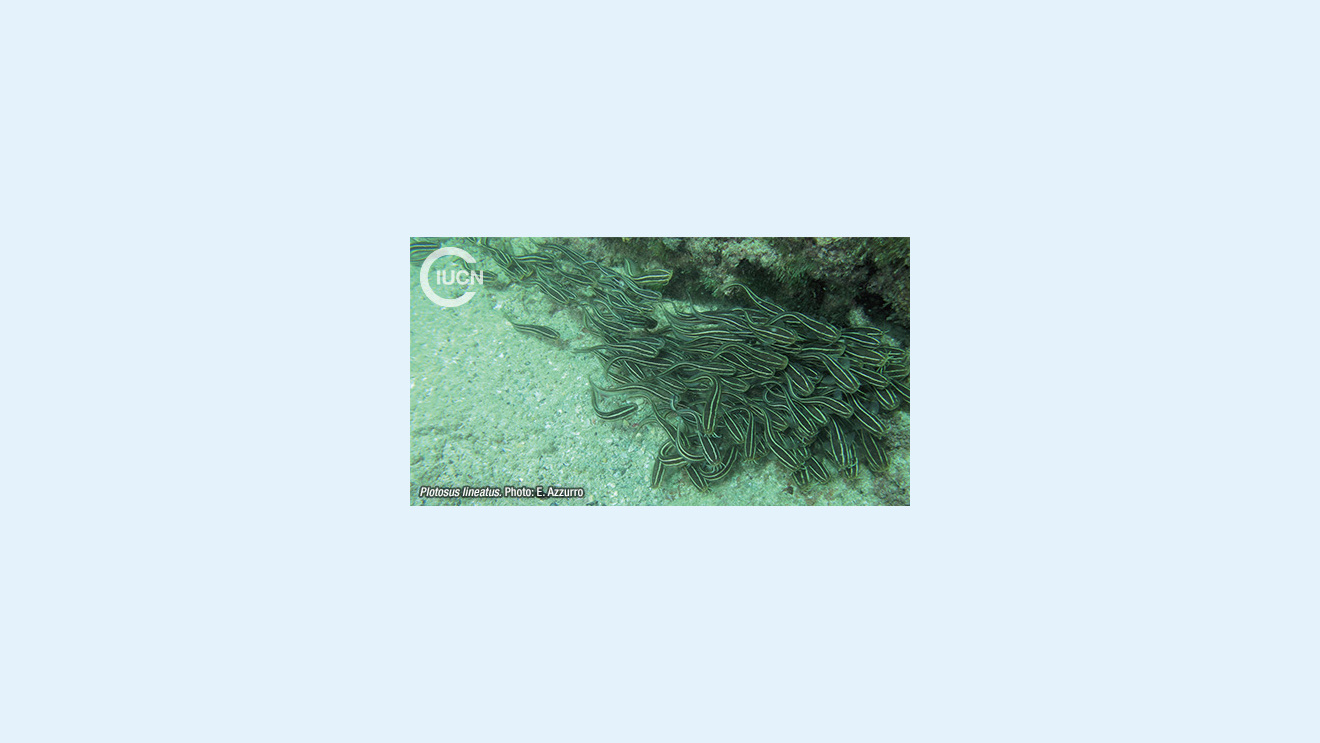
The juveniles form dense schools, sometimes containing hundreds of individuals. The adults, however, are solitary or occur in smaller groups of around 20 individuals and are known to hide under rock ledges during the day.
The adults are usually seen stirring the sand incessantly for crustaceans, molluscs, worms, and sometimes fishes.
Striped eel catfish reaches sexual maturity after 1–3 years, at a length of 140 mm. Spawning in Israel occurs in the spring and recruitment from July to September.
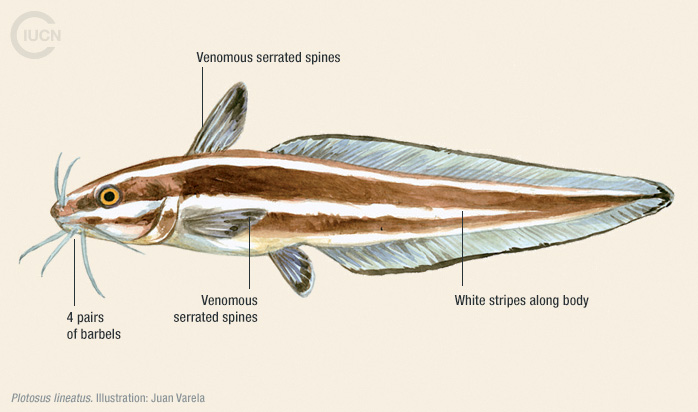
The four pairs of barbels together with the shape and colour of this catfish distinguish it from any other Mediterranean fish species.
This is an Indo-Pacific species, occurring in the Red Sea and East Africa eastwards to Japan, Australia and Micronesia. It entered the Mediterranean through the Suez Canal, and was first found in Israel in 2002 by trawlers. Within 3 years, it had spread along the entire Israeli coast and it now inhabits all sandy and muddy substrates down to depths of approximately 80 m.
It is a carnivorous species that feeds mostly on benthic invertebrates such as crustaceans, molluscs, polychaete worms and the occasional fish. The most dominant species consumed are other alien species from the Red Sea. It is thought that the increased abundance of these prey species may have set the stage for the catfish to migrate, resulting in a complete change to the native community structure.
Plotosus lineatus is taken as by-catch; however, there is no commercial value for this species because of the highly venomous serrate spine in the first dorsal and pectoral fins. The venom is dangerous, and even fatal in rare cases, posing a threat to fishermen. The striped eel catfish has however a significant commercial value in the aquarium industry.
Edelist D. et al., 2012. The invasive venomous striped eel catfish Plotosus lineatus in the Levant: possible mechanisms facilitating its rapid invasional success. Marine Biology, Vol 159, Issue 2, 283-290