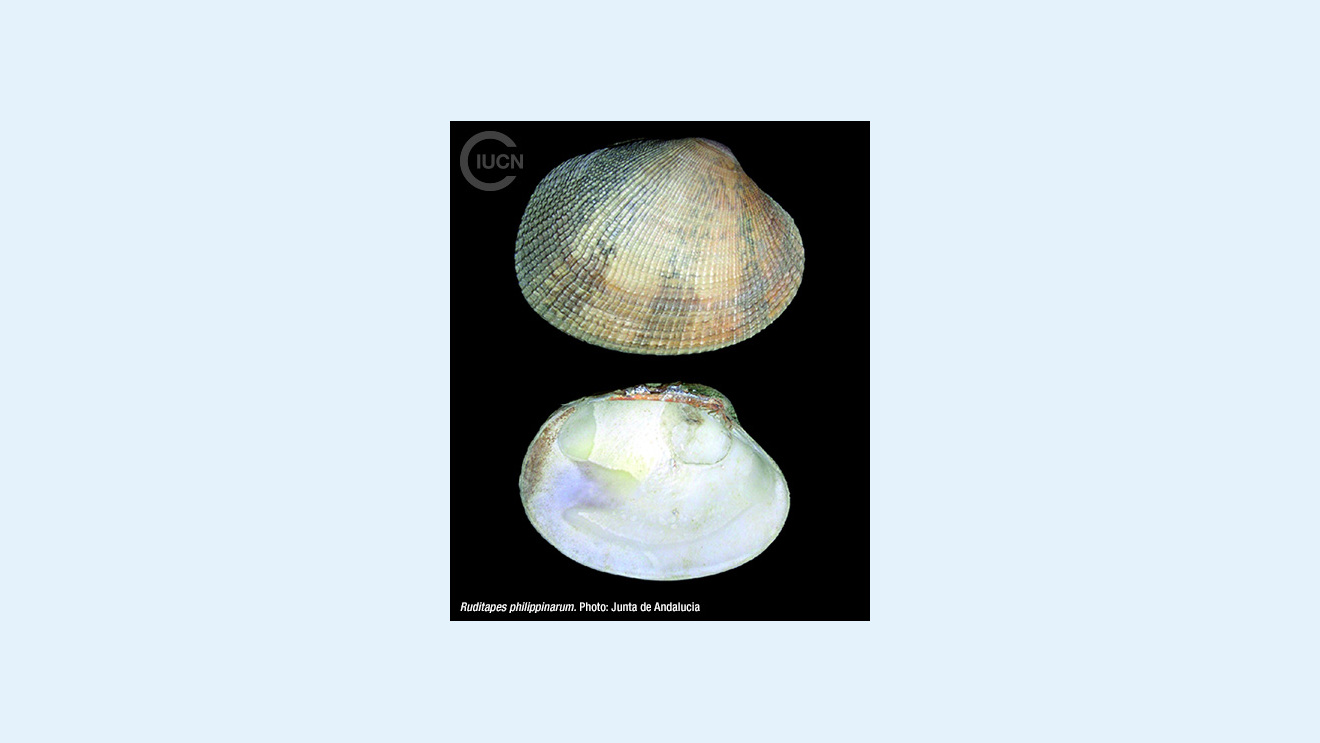
Venerupis (Ruditapes) philippinarum
Πληροφορίες
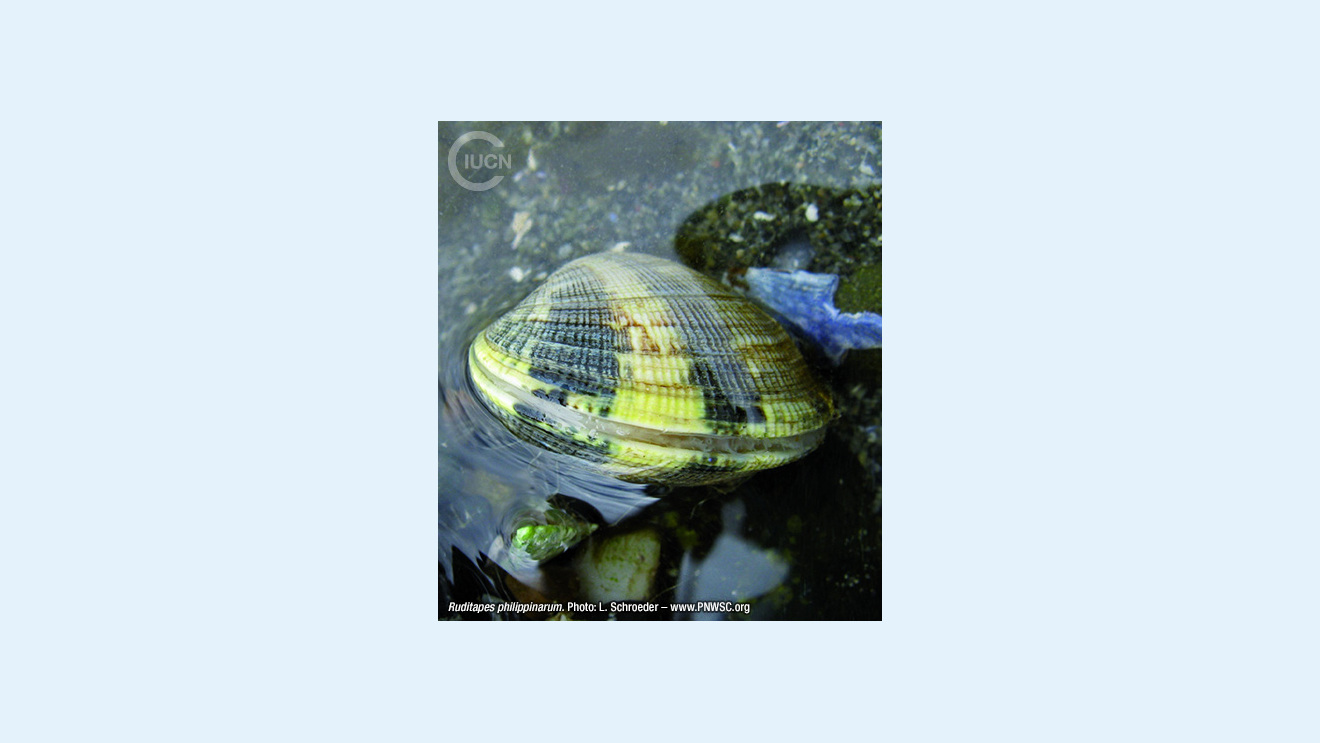
The Japanese carpet shell or Manila clam is a filterfeeder, generally found in estuaries and lagoons, on sandy and muddy bottoms, from the surface to a few metres’ depth. It can reach high concentrations of individuals (over 2,000 per square metre) and live for several days out of the water, as it is tolerant of a wide range of salinities, oxygen concentrations and temperatures.
It requires temperatures above about 12 °C to spawn and reproduction usually occurs from June to September at water temperatures of 20–23 °C. Its larvae spend 3–4 weeks drifting in the plankton, then settle to the bottom and attach by threads to rocks or shells.
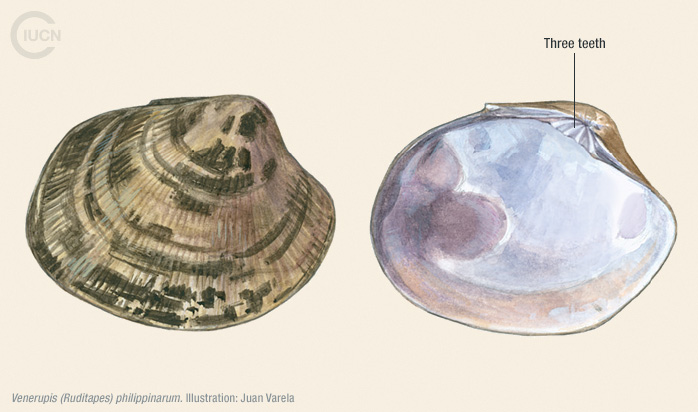
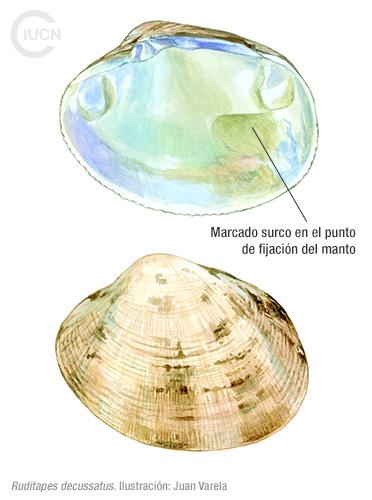
In the Mediterranean, the Japanese carpet shell Venerupis philippinarum is most likely to be confused with the cross-cut carpet shell clam, Ruditapes decussatus, whose shell surface has radiating and concentric ridges that are more widely spaced. In Ruditapes decussatus the outline of the shell is more elongated than oval, it lacks teeth inside the valves near the hinge, and the inside of the shell is generally completely white.
Venerupis philippinarum is native to the Indo-Pacific region. Broodstock was introduced for farming along the Atlantic coast of France to replace the native clam Ruditapes decussatus in 1972. Since then, culture has spread to the Mediterranean Sea in Italy, France and Turkey, the first seedlings having been introduced in the Venice lagoon in 1983. Wild populations now thrive in all the lagoons along the northern Adriatic coast and in other coastal areas.
Its high potential for dispersal, fast growth and great ability to adapt to new environments as an invasive species can have a major impact on the macrobenthic fauna and flora, since it competes for food and space with other filter-feeding invertebrates. It can supplant the indigenous grooved carpet shell, Venerupis decussata, and lead to the extinction of other local mollusc populations, as has been observed in the Venice lagoon.
An abundance of bivalves can significantly increase sediment erosion and re-suspension rates and overenrich sediments with biodeposits, leading to sediment anoxia which inhibits nitrification and kills benthic fauna. This species can destabilize the sediment, and it may also compete for resources with other species and inhibit their population recruitment by ingesting pelagic larvae, which may lead to changes in benthic communities.
The Japanese carpet shell is one of the most important species in shellfish farming. World production of this one species accounts for 20% of the global shellfish market. Italy is the largest European producer of Venerupis philippinarum with 90% of the market, worth over 100 million euros. The negative economic impact of the species has not yet been quantified.
Sladonja et al, 2011. Manila Clam (Tapes philippinarum Adams & Reeve, 1852) in the Lagoon of Marano and Grado (Northern Adriatic Sea, Italy): Socio-Economic and Environmental Pathway of a Shell Farm. Aquaculture and the Environment - A Shared Destiny, Dr. Barbara Sladonja (Ed.).
http://www.ciesm.org/atlas/Ruditapesphilippinarum.html
http://www.nobanis.org/MarineIdkey/Bivalvia/RuditapesPhilippinarum.htm